 I love the Byronic Hero, especially since I read 'Twilight History' by Nancy R Reagin. I hope you will find something to interest you too. If you're not a fan of the Twilight series (I admit I was late to the party,) chances are you've read and enjoyed Price and Prejudice, Jane Eyre and Wuthering Heights, all chock full of dashing Byronic heroes.
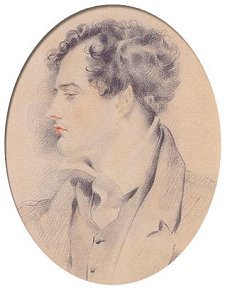
Lord Byron, sketch by G. H. Harlow, c 1815
It's no accident that the Twilight saga was such a blockbuster. Stephenie Meyer has done her research, and throughout the story, her attention to detail is amazing. 'They' say that much of the explanation for the success of Twilight is Edward's inhumanly angelic face and perfect, marble body. Twilight satisfies because its universe is both like and unlike ours. Stephenie Meyer's world building has been thought out to the last detail, and casting Edward as the Byronic hero was her coup de grace.
The Byronic Hero: Darcy, Rochester, Heathcliff and…Edward
We all love him or hate him – he’s the tall, dark brooding hero. The Byronic hero, based on the fictional characters of author Lord Byron, is a mysterious man, intelligent, sophisticated, educated, magnetic, charismatic, socially and sexually dominant while at the same time being detached from human society. We suffer his moods accompanied by his bouts of temper. His past is often troubled and he is riddled with self-destructive secrets.
Lord Byron himself, according to his lover Lady Caroline Lamb, was ‘mad, bad and dangerous to know.’ Recent examples of this type include Batman, Dr Gregory House from the television series House, MD, and the late actor James Dean.
The Byronic hero is sometimes called an anti-hero because of his negative qualities. Gilbert and Gubar compare him to a bewitching monster like Milton’s Satan – “He is in most ways the incarnation of worldly male sexuality, fierce, powerful, experienced, simultaneously brutal and seductive, devilish enough to overwhelm the body and yet enough a fallen angel to charm the soul.”
Now to Twilight and how Stephenie Meyer has used Edward to embody the Byronic hero. The Byronic hero's mystery, moodiness and sensuality call to mind Bella’s reaction to Edward in their meadow: “I sat without moving, more frightened of him than I had ever been. I’d never seen him so completely freed of that carefully cultivated façade. He’d never been less human…or more beautiful. Face ashen, eyes wide, I sat like a bird locked in the eyes of a snake.” (Twilight, 264.)
At several points in the saga, Bella notes that Edward’s beauty is terrifying. She describes being captivated by Edward as “locked in the eyes of a snake,” yet she also describes him as an angel.
Early in their meeting, when Bella tries to get Edward to explain how he saved her from being crushed by Tyler’s van, Bella thinks, “I was in danger of being distracted by his livid, glorious face. It was like trying to stare down a destroying angel.” (Twilight, 65.) And in Breaking Dawn, she says, “His face glowed with an expression of triumph that I didn’t understand – it was the expression an angel of destruction might wear while the world burned. Beautiful and terrifying.” (730).
But...the Byronic hero is not simply seductive and strong, he is also tormented. He is well aware of his flaws even as he despises them in others; his introspection often leads him to black moods and self-destructive behaviour. Edward has a penchant for self-flagellation, as does Darcy, Rochester and Heathcliff. Pride and Prejudice and Wuthering Heights are explicitly mentioned in the saga. Foremost is Edward’s name. Bella comes across it in Austen’s works, leading her to wonder, “Weren’t there any other names available in the late eighteenth century?” (Twilight, 148.) In Wuthering Heights we have Edgar and Isabella Linton. In Jane Eyre, Rochester’s first name is Edward.
Colin Firth's Mr Darcy

