Go here if you're looking for my post for the A-Z Challenge. Currently showing is Q for Queenlsand. Next is R for ...and you won't want to miss this personal anecdote...
And a warm welcome to all my new followers who have joined me here at L'Aussie Writing. I appreciate each one of you and have visited you if there was a link, or if you left a comment.
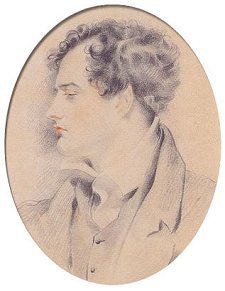
Now onto our Byronic Hero. Today we compare Rochester and Edward Cullen.
Edward Rochester, the hero of Charlotte Bronte's Jane Eyre (1847), feels no guilt for wooing Jane, even though he is already secretly married. When Jane learns of the existence of the mad Bertha Mason, kept imprisoned in the attic at Thornfield Hall, Rochester says: "I am little better than a devil at this moment." He wants to keep Jane as his mistress, but Jane refuses and flees.
At the end of the novel when Jane returns to find a blind and maimed Rochester, he finally expresses some guilt that he is no longer worthy of Jane: "I am no better than the old lightning-struck chesnut tree in Thornfield orchard...And what right would that ruin have to bid a budding woodbine cover its decay with freshness?"
Rochester's guilt feelings are remarkably short-lived and he and Jane marry immediately.
Rather than being tormented by guilt, like many Byronic heroes, Rochester primarily suffers from the effects of his dark secret which renders him mysterious and frightening. Jane describes him as proud, sardonic, moody, imperious, morose. Just as Edward tends to brood, most often about how his vampirism will affect Bella, so too is Rochester melancholy, though he does not blame himself for his dark secret.
Rochester's isolation is reminiscent of Edward's ninety years without a mate: they both feel doomed to solitude. In Twilight, Alice tells Bella, "It's been almost a century that Edward's been alone. Now he's found you. You can't see the changes that we see, we who have been with him for so long. Do you think any of us want to look into his eyes for the next hundred years if he loses you?" (Twilight, 410-411.)
Have you given any thought to the equation between the mad Bertha and Edward's vampirism? When Jane tells Rochester about her vision of the woman with the "fiery eye", "lurid visage" and "gaunt head" who tears her wedding veil, she says it reminded her "of the foul German spectre - the Vampyre." Jane's descriptions of Rochester bear a strong resemblance to Edward - his "flaming and flashing eyes,: his "pale, firm, massive front: like "quarried marble," his face like "colourless rock," and "His eye...was a black eye: it had now a tawny, nay a bloody light in its gloom." Remind you of anyone?
Rochester tries to control the woman he loves, as does Edward. Citing their advanced ages, both Edward and Rochester often take charge of Bella and Jane. While Edward has ninety years on Bella (helped along by a bit of mental telepathy), Rochester says, "I claim only such superiority as must result from twenty years' difference in age and a century's advance in experience." Edward says: "I'm going to be a little...overbearingly protective...I wouldn't want you to think I'm naturally a tyrant." (Twilight, 328.)
Edward and Rochester feel compelled to confide in their love objects. Rochester: "Strange that I should choose you for the confidant in all this...(you) were made to be the recipient of secrets." Edward says: "Having you know about everythng, not needing to keep secrets from you. It makes me...happy." (Twilight, 344.)
There is relief for the Byronic hero as he unburdens his soul of terrible secrets: the absolute honesty that he shares with his love forges their unbreakable connection.
Here is a great blog post on the same topic. And here is another, specifically on Rochester.
With thanks to Nancy R Regin, "Twilight and History."

And a warm welcome to all my new followers who have joined me here at L'Aussie Writing. I appreciate each one of you and have visited you if there was a link, or if you left a comment.
Now onto our Byronic Hero. Today we compare Rochester and Edward Cullen.
Edward Rochester, the hero of Charlotte Bronte's Jane Eyre (1847), feels no guilt for wooing Jane, even though he is already secretly married. When Jane learns of the existence of the mad Bertha Mason, kept imprisoned in the attic at Thornfield Hall, Rochester says: "I am little better than a devil at this moment." He wants to keep Jane as his mistress, but Jane refuses and flees.
At the end of the novel when Jane returns to find a blind and maimed Rochester, he finally expresses some guilt that he is no longer worthy of Jane: "I am no better than the old lightning-struck chesnut tree in Thornfield orchard...And what right would that ruin have to bid a budding woodbine cover its decay with freshness?"
Rochester's guilt feelings are remarkably short-lived and he and Jane marry immediately.
Rather than being tormented by guilt, like many Byronic heroes, Rochester primarily suffers from the effects of his dark secret which renders him mysterious and frightening. Jane describes him as proud, sardonic, moody, imperious, morose. Just as Edward tends to brood, most often about how his vampirism will affect Bella, so too is Rochester melancholy, though he does not blame himself for his dark secret.
Rochester's isolation is reminiscent of Edward's ninety years without a mate: they both feel doomed to solitude. In Twilight, Alice tells Bella, "It's been almost a century that Edward's been alone. Now he's found you. You can't see the changes that we see, we who have been with him for so long. Do you think any of us want to look into his eyes for the next hundred years if he loses you?" (Twilight, 410-411.)
Have you given any thought to the equation between the mad Bertha and Edward's vampirism? When Jane tells Rochester about her vision of the woman with the "fiery eye", "lurid visage" and "gaunt head" who tears her wedding veil, she says it reminded her "of the foul German spectre - the Vampyre." Jane's descriptions of Rochester bear a strong resemblance to Edward - his "flaming and flashing eyes,: his "pale, firm, massive front: like "quarried marble," his face like "colourless rock," and "His eye...was a black eye: it had now a tawny, nay a bloody light in its gloom." Remind you of anyone?
Rochester tries to control the woman he loves, as does Edward. Citing their advanced ages, both Edward and Rochester often take charge of Bella and Jane. While Edward has ninety years on Bella (helped along by a bit of mental telepathy), Rochester says, "I claim only such superiority as must result from twenty years' difference in age and a century's advance in experience." Edward says: "I'm going to be a little...overbearingly protective...I wouldn't want you to think I'm naturally a tyrant." (Twilight, 328.)
Edward and Rochester feel compelled to confide in their love objects. Rochester: "Strange that I should choose you for the confidant in all this...(you) were made to be the recipient of secrets." Edward says: "Having you know about everythng, not needing to keep secrets from you. It makes me...happy." (Twilight, 344.)
There is relief for the Byronic hero as he unburdens his soul of terrible secrets: the absolute honesty that he shares with his love forges their unbreakable connection.
Here is a great blog post on the same topic. And here is another, specifically on Rochester.
With thanks to Nancy R Regin, "Twilight and History."