Showing posts with label Darcy. Show all posts

Tuesday, 26 April 2011

Byronic Hero Series, Part 4 - Heathcliff from Wuthering Heights compared to Edward Cullen and Twilight.


The Byronic Hero

For those of you who are visiting my posts for the first time, I have been finding parallels between the recent blockbuster series Twilight and checking out how clever author Stephenie Meyer has drawn from the classics - Pride and Prejudice, Jane Eyre and Wuthering Heights in particular. The Twilight hero, Edward, (sorry Team Jacob) shares many of the attributes of the Byronic Hero (read my first post of the series below if you want the background.)

Darcy's Byronic Hero has an overbearing ego, Rochester exhibits moody paternalism, but Heathcliff from Emily Bronte's Wuthering Heights, is exotic and savage, in contrast to the civility of Imperial Britain. Nelly describes Heathcliff after he returns from making his fortune: "...half-civilized ferocity lurked yet in the depressed brows and eyes full of black fire..." His innate wildness has not been subdued.


Heathcliff's wildness sometimes manifests as brutality. He becomes monstrously cruel, killing a lapdog, and taunting Linton and Catherine. Edward Cullen's "monstrosity" is his vampirism, against which he fights a daily battle. Edward never exhibits the unrestrained cruelty of Heathcliff, but he does admit "a typical bout of rebellious adolescence" where he hunted and killed humans." (Twilight, 342.) Even though Edward has become a "vegetarian" vampire, the reader knows he possesses the barbarous power to kill James, Victoria, or anyone who would hurt Bella.

Wuthering Heights is the only one of Bella's novels mentioned in each of the Twilight Saga's four books, with one exception, New Moon. This is a little odd, since the plot of New Moon closely mirrors Wuthering Heights more so than any of the other books. Like Wuthering Heights, New Moon begins with Edward and Bella's carefree happiness, the English moors replaced with meadows outside Forks. Edward abandons Bella in New Moon, which emotionally destroys her and she begins to recklessly act out. She takes to riding motorbikes and cliff-diving. But despite all this, she still rushes to his vampire's deathbed (in Volterra) driven by love. When Edward returnds to Bella he says: "As if there were any way that I could exist without needing you!" (New Moon, 510.) Bella sees her situation in Eclipse as similar to the plot of Wuthering Heights when she is torn between Jacob and Edward, just as Cathy is torn between Edgar and Heathcliff.

Edward himself identifies with Heathcliff during Eclipse. He denigrates Heathcliff at first, calling Heathcliff and Cathy "ghastly people who ruin each other's lives." He later changes his mind. "The more time I spend with you, the more human emotions seem comprehensible to me. I...can sympathise with Heathcliff in ways I didn't think possible before." (Eclipse, 28,265.)


Heathcliff is likened to a vampire by Nelly when he roams the moors alone at night. When Edward re-reads Bella's copy of Wuthering Heights, he leaves the book open where it shows Heathcliff describing his rival Edgar Linton in almost vampiric terms "Had he been in my place...though I hated him with a hatred that turned my life to gall, I never would have raised a hand against him...I never would have banished him from her society, as long as she desired his. The moment  her regard ceased, I would have torn his heart out, and drank his blood!" Edward, however, says he sympathises with Heathcliff, perhaps becuase he is overcoming his Byronic savagery by trying to become more human.

The flip side of the Byronic hero's savagery is his passionate attachment to his love. As children, Heathcliff and Cathy are inseparable, appearing to share even the same soul as they run wild over the moors. Their perfect happiness is ruined when Cathy convalesces at Thrushcross Grange and falls under the influence of the Lintons, determining to marry Edgar Linton, while at the same time saying: "I am Heathcliff-he's always, always in my mind-not as a pleasure, any more than I am always a pleasure to myself-but as my own being." It is not until Cathy is dying that Heathcliff reveals the depth of his ardor. He rushes to Cathy's sick room, "he gnashed at me, and foamed like a mad dog, and gathered her to him with greedy jealousy" Nelly says. "Be with me always-take any form-drive me mad! Only do not leave me in this abyss, where I cannot find you! Oh, God! It is unutterable! I cannot live without my life...without my soul!" Edward quotes this final line of Heathcliff's, after Bella's quotes Cathy's lament to him: "If all else perished, and he remained, I should still continue to be; and if all else remained, and he were annihilated, the universe would turn to a mighty stranger." (Eclipse, 611.)


I hope you have enjoyed this series, and whether you agree or disagree with the parallels I've found, I hope you've found the posts enjoyable and thought more deeply about the classics and maybe are inpired to read Twilight if you haven't yet succumed. I recommend Twilight and History by Nancy Reagin if you'd like to read more.

Have you read any books that you can't help seeing parallels with well-known classics? Tell me about it...

Monday, 11 April 2011

The Byronic Hero - Part 2 Darcy Fitzwilliam of Pride and Prejudice, Edward Cullen of Twilight, and their love objects...

The Byronic Hero
Thanks for your reactions to my last post. No one had any trouble accepting Darcy, Rochester or Heathcliff as Byronic heroes but some found Edward not in the same class. Well, like I said last post, there are some things we understand in our world and some things are from another world.

I'm going to let the novels do the talking.


Today Darcy takes centre stage, just where he likes to be. When we meet him in Pride and Prejudice (1815) he is an object of fascination for the heroine, Elizabeth Bennet. Darcy is moody, cold, superior and judgmental, yet Elizabeth feels a strong attraction to him despite his aloofness.

In accordance with the reverence due a Byronic hero, when Mr Darcy arrives at the ball in Hertfordshire, he is immediately admired: "Mr Darcy soon drew the attention of the room by his fine, tall person, handsome features, noble mien; and the report which was in general circulation within five minutes after his entrance, of his having ten thousand a year." This admiration turned to disgust during the evening as he was perceived as "proud, to be above his company, and above being pleased."

Like Darcy, Edward makes a strong first impression in the cafeteria. Bella is immediately astounded by him. Jessica Stanley tells Bella that "He's gorgeous...but don't waste your time. He doesn't date. Apparently none of the girls here are good looking enough for him." (Twilight, 22.)


For those ignorant of Twilight, that is the brooding Edward on the right.

Both Darcy and Edward are set apart by their emotional distance.


Darcy offends Elizabeth at the ball. He says: "She is tolerable; but not handsome enough to tempt me; and I am in no humour at present to give consequence to young ladies who are slighted by other men." His haughty rejection of Elizabeth is reminiscent of Edward's expression when Bella is seated next to him in class: "I peeked up at him...,and regretted it. He was glaring down at me..., his black eyes full of revulsion. As I flinched away from him, shrinking against my chair, the phrase if looks could kill suddenly ran through my mind." (Twilight, 24.) Edward is reacting to the overwhelming scent of Bella's blood, Darcy soon decides Elizabeth is "uncommonly intelligent by the beautiful expression of her dark eyes." Like all good Byronic heroes, Edward and Darcy feel self-disgust, even if it is aimed at their love objects.

Neither Elizabeth nor Bella believe they are desired. Elizabeth is disquieted by "how frequently Mr Darcy's eyes were fixed on her...She could only imagine that she drew his notice because there was something about her more wrong and reprehensible, according to his ideas of right..." In the meadow, Bella despairs: "He was too perfect...There was no way this godlike creature could be meant for me." (Twilight, 256.)

When Edward and Darcy declare themselves, it is phrased like surrender. Darcy says, "In vain have I struggled. It will not do. My feelings will not be repressed. You must allow me to tell you how ardently I admire and love you." Edward tells Bella, "I'm tired of trying to stay away from you," and "You are the most important thing to me now..." (Twilight, 85,273.)


I hope you enjoyed this post on Mr Darcy, er, Colin Firth. Tell me what you think...


Friday, 8 April 2011

The Byronic Hero - Darcy, Rochester, Heathcliff and ...Edward.

I love the Byronic Hero, especially since I read 'Twilight History' by Nancy R Reagin. I hope you will find something to interest you too. If you're not a fan of the Twilight series (I admit I was late to the party,) chances are you've read and enjoyed Price and Prejudice, Jane Eyre and Wuthering Heights, all chock full of dashing Byronic heroes.

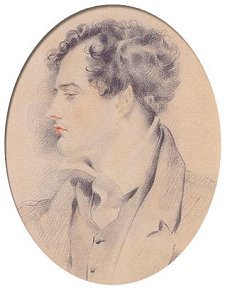
 Lord Byron, sketch by G. H. Harlow, c 1815

It's no accident that the Twilight saga was such a blockbuster. Stephenie Meyer has done her research, and throughout the story, her attention to detail is amazing. 'They' say that much of the explanation for the success of Twilight is Edward's inhumanly angelic face and perfect, marble body. Twilight satisfies because its universe is both like and unlike ours. Stephenie Meyer's world building has been thought out to the last detail, and casting Edward as the Byronic hero was her coup de grace.

The Byronic Hero: Darcy, Rochester, Heathcliff and…Edward


We all love him or hate him – he’s the tall, dark brooding hero. The Byronic hero, based on the fictional characters of author Lord Byron, is a mysterious man, intelligent, sophisticated, educated, magnetic, charismatic, socially and sexually dominant while at the same time being detached from human society. We suffer his moods accompanied by his bouts of temper. His past is often troubled and he is riddled with self-destructive secrets.

Lord Byron himself, according to his lover Lady Caroline Lamb, was ‘mad, bad and dangerous to know.’ Recent examples of this type include Batman, Dr Gregory House from the television series House, MD, and the late actor James Dean.

The Byronic hero is sometimes called an anti-hero because of his negative qualities. Gilbert and Gubar compare him to a bewitching monster like Milton’s Satan – “He is in most ways the incarnation of worldly male sexuality, fierce, powerful, experienced, simultaneously brutal and seductive, devilish enough to overwhelm the body and yet enough a fallen angel to charm the soul.”

Now to Twilight and how Stephenie Meyer has used Edward to embody the Byronic hero. The Byronic hero's mystery, moodiness and sensuality call to mind Bella’s reaction to Edward in their meadow: “I sat without moving, more frightened of him than I had ever been. I’d never seen him so completely freed of that carefully cultivated façade. He’d never been less human…or more beautiful. Face ashen, eyes wide, I sat like a bird locked in the eyes of a snake.” (Twilight, 264.)

At several points in the saga, Bella notes that Edward’s beauty is terrifying. She describes being captivated by Edward as “locked in the eyes of a snake,” yet she also describes him as an angel.

Early in their meeting, when Bella tries to get Edward to explain how he saved her from being crushed by Tyler’s van, Bella thinks, “I was in danger of being distracted by his livid, glorious face. It was like trying to stare down a destroying angel.” (Twilight, 65.) And in Breaking Dawn, she says, “His face glowed with an expression of triumph that I didn’t understand – it was the expression an angel of destruction might wear while the world burned. Beautiful and terrifying.” (730).

But...the Byronic hero is not simply seductive and strong, he is also tormented. He is well aware of his flaws even as he despises them in others; his introspection often leads him to black moods and self-destructive behaviour. Edward has a penchant for self-flagellation, as does Darcy, Rochester and Heathcliff. Pride and Prejudice and Wuthering Heights are explicitly mentioned in the saga. Foremost is Edward’s name. Bella comes across it in Austen’s works, leading her to wonder, “Weren’t there any other names available in the late eighteenth century?” (Twilight, 148.) In Wuthering Heights we have Edgar and Isabella Linton. In Jane Eyre, Rochester’s first name is Edward.


The Byronic parallels among Edward, Darcy, Rochester are many. I will continue to explore this topic next post.

Colin Firth's Mr Darcy