Showing posts with label #wepff. Show all posts

Wednesday, 20 October 2021

#WEP #OCTOBER #CHALLENGE for #TheScream - My #flashfiction - 'The Child'

 Hello friends!

Two months have gone by since the last WEP. Here we are again, nearing the end of the year. 

October is our scream-fest, but it doesn't have to be if horror isn't your thing. 

Talking about horror, most of us watched in horror at the allies' retreat from Afghanistan after 20 years of occupation. Images of those poor people running in front of departing aeroplanes is seared into our collective memory. 

I'm telling this story before it's completely out of date. The story of an Australian soldier who failed to understand  the challenges of going on patrol in Kandahar province, the area where the Australians were stationed.

I gleaned most of this story through research (I've written a book set in Afghanistan, as yet unpublished) and sprinkled it with a lot of imagination, thinking it suits The Scream for sure.


­­THE CHILD

 My first mission in Afghanistan. As we marched out in single file, my head thumped with the headache from hell. Ahead, the desert, pitch-black, silent. The only sound the Call to Prayer ringing across the Baluchi Valley, punctuating the silence with staccato bursts. The feral dogs joined in and soon their barking matched the cacophony of sound.

 I struggled through cool sand, so thick around my ankles it sucked at my regulation boots.

 I followed the soldier in front of me, his form a shadow in the darkness. Exhaustion threatened to overwhelm me. I’d had no sleep the night before, so terrified was I at the spectre of marching into the unfamiliar mountains and deserts of Kandahar province in one of the most treacherous countries on earth. The lead soldiers were obviously a lot fitter than I, a newly arrived recruit. I fought the sand – my knees screamed, my thighs burned, my lungs were on fire.

 I was in another world, a world where I’d been warned that nothing was as it appeared.

 Who was friend?

Who was foe?

 Making the wrong choice could result in death.

 I was on covert foot patrol with Australian and Afghan soldiers.  We were outside the wire, scaling rocky hills under the pressing weight of body armor and supplies. The altitude was an unwelcome foe. I hadn’t had time to acclimatise to the blistering temperatures.

 I tripped and fell onto my knees, thankful that the sand cushioned the fall.

 No one stopped to help me. On patrol, to stop would jeopardise the mission. I dragged my feet from the sand and hurried back to my position. No princesses here! In uniform everyone is treated the same.

 How I prayed for sunrise.

~*~

 After what seemed like hours, the lead soldier signalled with his crooked finger, pointing to our surroundings, then holding a finger to his lips. Word whispered down the line. Silence. Kuchi camps. Bedouins.

 We moved on again, soundlessly into the night, every sense screaming.

 ‘Police checkpoint’, someone whispered.

 In briefing I’d been told even if we had nothing to hide, these checkpoints were best avoided.

 No one even breathed as we crouched and duck-walked close to the ground, swinging our weapons from side to side, holding tight, hoping to elude the inevitable searchlight.

 A screech, a huge spotlight shone down on us, blinding us in white light.

­­Someone screamed ‘Drescht! (Stop!)’. We froze, startled deer, clutching weapons to our chests.

 Two policemen yelled at us in a language I didn’t understand, but the meaning was clear. They motioned us to our feet.

 We stood. Statues. I fought to control my bladder. We could be shot right where we stood.

 Our leader yelled, ‘Australians!’

 The police muttered to each other, came close, pointed weapons in our faces, checked papers, nodded, then motioned us on.

 Shaken, we headed further into the desert darkness.

 ‘The guards were skittish because just yesterday they confronted insurgents in Kakarak across the river. Shots were exchanged,’ hissed the soldier behind me.

 ‘Thanks,’ I muttered, but it didn’t comfort me. My eyes saw insurgents behind the rocks, across the river, in the mountains.

 I was weak with terror after my first date with danger. My legs collapsed. I fell out of line. Sat down in a dry gully, sucked air into my parched lungs.

 Back on my feet, I rushed to join the line again, terrified of being left behind.

                                                                   ~*~

 Sunrise.

 A glorious orange orb broke over the mountains, into the valley, and lit up the shock of green land we were heading toward, the green belt.

 In the near distance I saw a small boy, no more than six years old, shepherding his family’s goats through the pastures. He could be my son, but my little boy slept in cosy comfort, surrounded by stuffed toys and his father’s love. More children hid shyly in the doorways of simple rammed-earth homes.

 Watching. Watching. Watching.

 First stop. A meeting with the elders of the tribe. They were guarded, constantly looking to see if they were being observed. Not everyone would be happy to see them talking to Australian soldiers. They risked death for having a conversation with us. We kept it short to minimise the danger, then moved on.

 Over broken bricked walls, through crumbling aqueducts, we waded towards the village of Sorkh Morghab where coalition forces had built a school, market and medical centre. Yet, despite all our efforts, I’d been told it was hostile.

 We wandered through the village, apparently casually, weapons held across our chests, trigger fingers ready. We progressed through the market area, where men and young boys showed us their shops and tried to sell me a burqa. I was just a woman, one who needed to cover herself.

 One little boy approached me, hand outstretched. He, too, about six years old. I thought again of my son, but this little boy’s eyes reflected a man, an angry man. I shivered at the hate in those big black eyes.

 A soldier pulled me backward. ‘Step away,’ he said. ‘Nothing is as it seems.’

 I brushed him off. Reached into my pocket. Pulled out two lollies for the poor little boy. He was only a child.

 The child smiled a toothy smile, but it didn’t reach his old man eyes. He dived into his pocket and pulled out what looked like a large apple.

 We smiled at each other in what was a very easy but powerful gesture. No words needed.

 I saw the apple had gone black with age and looked rough and mouldy. It looked like a … it couldn’t be...

                                                                  ~*~

‘Nooooooooooo …’ someone screamed, a voice full of pain and regret.

 I felt the fire on my lips, the fire in my belly.

 I tasted the fire as it burned down my throat.

 I heard voices and the staccato bursts of gunfire.

 I heard the cry of a child.

 Then I heard … nothing.


THE END


TAGLINE: Trust is not a given. Sometimes you reach for an apple and are handed a grenade. 


WORDS: 997
FCA


Thank you for reading my entry for The Scream 

Please click on names in my sidebar to read more entries in this writing competition.

Please consider joining us for the final challenge for the year - Narcissus


Wednesday, 15 April 2020

#WEPff entry for #WEPApril #writingchallenge. My #flashfiction - It was Evie's Idea - a #Covid-19 story.

Whoops! This published a tad early. Never mind. WEP is live in 5 hours... 

Hello all who come by!

It's time for the #AprilWEP challenge. During this time of Covid-19 and the challenges it brings, many of us are finding strength, more than ever, in our writing. 

My flash came to me when I woke one morning a few weeks' ago, no doubt brought on by the constant inundation of Covid-19 news stories from around the world.

I hope you enjoy my story, which when I analyse it, is a love letter to Santorini in the Greek Islands where I spent a wonderful day a couple of years ago. Like my hero, not long enough.

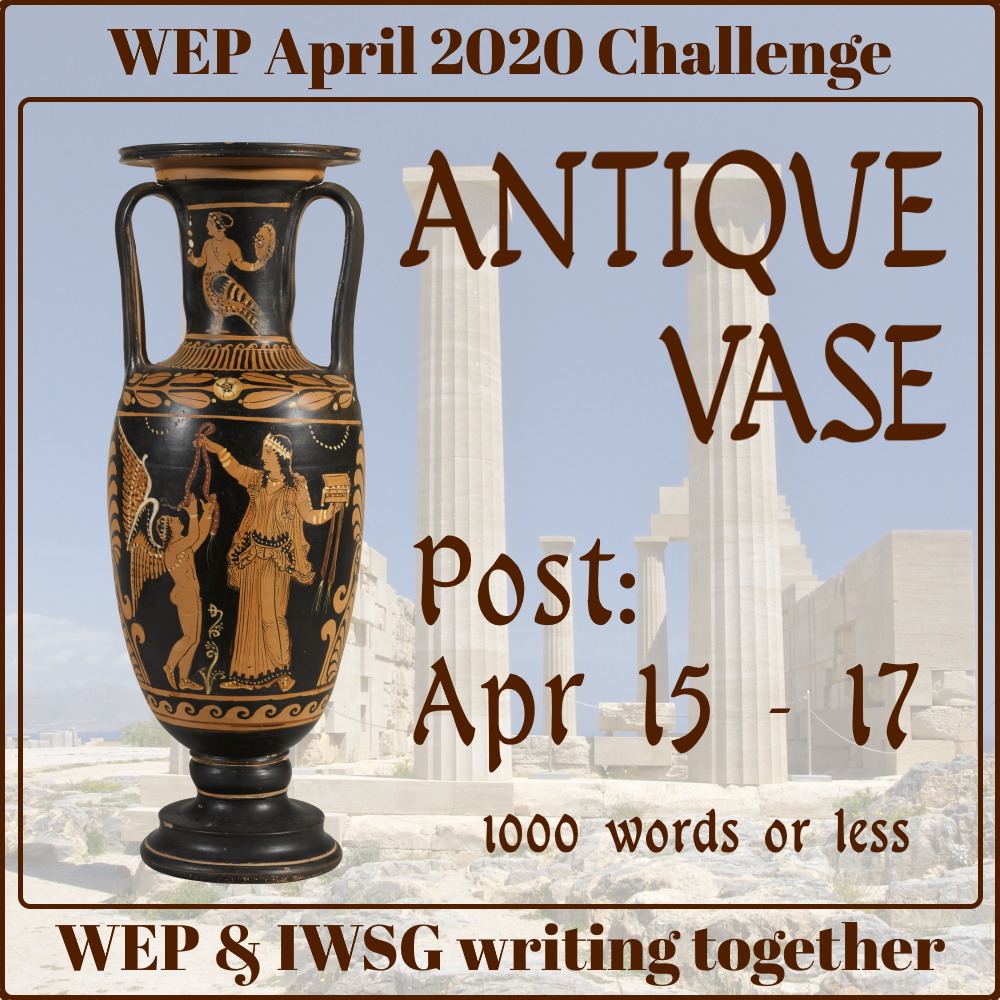
WEP CHALLENGE FOR APRIL 2020! - OUR CHALLENGE - ANTIQUE VASE.

EVIE’S IDEA

It was Evie’s idea to holiday on the Greek Islands, to spend a day on Santorini, the insanely beautiful jewel set in the Aegean Sea.

It was Evie’s idea to walk every square mile of that island, to explore every cave where in World War 11 she told me the locals hid from the German invaders, spending days and nights huddled together, existing on raw onions and grass, all that stood between them and mass starvation.

That was until the Germans discovered the caves and the onions. There was nothing left for the island inhabitants.

They suffered.

They starved.

They died.

As we walked through the streets of Oia along the ridge overlooking the waterfront, Evie regaled me with history of the Greek Islands I never knew, history she’d kept to herself. ‘To prolong life, the islanders bartered everything they owned, everything they couldn’t eat. Their possessions were few. Just old bowls and utensils belonging to their parents and their parents before them, all the way back to antiquity. They didn’t know these relics would one day be considered valuable. All that was valuable at the time was their lives and the lives of their children.'

++++++++++++++++++++++++++++++++++++

Hustling along the beautifully tiled streets of Oia, Evie grew increasingly irritated by the crowds. They pushed their way along the ridge, stopping to take in the breathtaking view over the sea, cameras snapping the whitewashed buildings tottering down the cliffside.

Up and down one set of narrow concrete stairs after the other.

Where to Stay in Santorini - Neighborhoods & Area Guide - The ...

Then Evie grabbed my arm. She spied the vase. An antique vase. Perched on its pedestal. In the window of the smallest shop I’d ever seen.

‘Look.’ She pointed to the whitewashed walls, the bright blue painted door, the red checked curtains framing the windows. ‘Isn’t it darling?’

Evie thought everything was darling, except the hot mess of tourists pushing and shoving, anxious to cram everything into this island-hopping experience, anxious not to miss the ship which left in two short hours. When they looked down the hill to Fira, the capital, their cruise ship loomed like a threat.

‘Evie, let’s keep moving. There’s still a lot to discover.’

She stood gazing in the window, mesmerized. ‘I must have it,’ she said, clambering down two steep steps into the tiny hole-in-the-wall-dusty-with-desperation shop.

The vase didn’t look as good at close range as it had from the window. Its main features were covered in years of dust and grime. How long had it been sitting there, waiting? Evie’s lineage was Greek and by the rapt look on her face as she traced the delicate lines of the vase, I saw that she was transported back in time to the stories from her mother’s childhood during the German occupation, how they’d survived on a diet of onions and grass.

The old Greek shopkeeper approached, his eyes rheumy, his hair tousled and falling past his shoulders, his front teeth missing as he beamed at us.

I insisted on checking the base to see if it said made in China, but no, it seemed genuine, something we could take along to the Antique Roadshow next time it came to Yorkshire.

‘There are very few of these old vases left,’ the old guy said, lighting up a filthy-smelling cigar and blowing smoke at the vase. ‘This one I found myself in a cave high up in the hills near the caldera. Someone had buried it aeons ago. Must have been their treasure. You are the first to show an interest. Perhaps it was meant for you.’

We made it down the chairlift to the boat, bathed in the glorious marmalade sunset over the Aegean Sea.

Two Amazing Spots to Watch the Sunset in Oia, Santorini | Earth ...

Evie clutched her vase to her chest as we stood on the deck, watching the twinkling lights of Santorini disappear. Her eyes were alight with the fervour one feels when given a peek into the past.

‘We must come back soon,’ she whispered, tears running down her cheeks.


                                    ++++++++++++++++++++++++++++++++++++


Home again

I checked in on Evie every evening. We’d share a glass of ouzo and toast to our next trip. Both being alone, we loved to travel together.

‘I must go back to Santorini,’ she said, a week after we arrived home. ‘I want to spend days, not hours, exploring. I want to know more about my ancestors. When I listened to mother’s stories, I was detached. Now I’m invested.’

As we planned our next travel adventure, she nodded at the vase in pride of place on her mantlepiece.

The vase. Evie was completely obsessed.

I had to admit it was beautiful with its classic lines, its black silhouette figures, its scrolls.

Then Evie took sick.

We’d congratulated ourselves on making it home before Covid-19 hit, but it appeared we hadn’t.

Evie tested positive.

I tested negative.

The hospitals struggled to contain the outbreak.

Evie demanded she isolate at home.

I was no nurse, so I hired one. I did everything I could. But Evie was over seventy. In the high-risk category.

Her descent was swift.

Hospital. Intensive care. Respirator. It killed me to watch her through the glass, gasping for breath as pneumonia took over her lungs.

Dressed in my hazmat suit, mask and gloves, I was allowed a minute to say goodbye.

Her bony hand reached for mine. ‘Son,’ she said, ‘Come close. Listen.’


                                      ++++++++++++++++++++++++++++++++++++


After the outbreak was over, I sipped ouzo on my tiny terrace in the cave-house AirBNB in Oia, anticipating the sunset, talking to the antique vase in the center of the glass table.

‘Evie. Mother. I’m back. I brought you to your favorite place. We didn’t have much time that day. Now you have eternity.’

At sunset, as the golden-orange-pink tipped sun dipped into the Aegean Sea, I made my way down the rocky slope to the rocky shore, my arms covered in red welts from the riotous red bougainvillea growing wild, snatching at me each step I took. I reached the beach made up of black, red and white lava pebbles.

Mind Games - 1000 EUR Oia, Santorini Greece -

I uncapped the lid of the precious antique vase. ‘Goodbye Mother.’ Her ashes caught the wind.

It was Evie’s idea.

Her final resting place would be the Aegean Sea.

                                        ++++++++++++++++++++++++++++++++++++

WORDS: 1,010
FCA

Go HERE to read more WEP stories for ANTIQUE VASE.

If you haven't yet participated in WEP writing challenges, or you've backslidden, we warmly invite you to participate in two months' time for our June challenge: 


I'm writing this over the Easter weekend, eagerly anticipating Andrea Bocelli's Easter Sunday concert on youtube. Here he sings a favorite of mine. Very apt during this time of Covid-19.


Enjoy my post? Please hit my buttons!

Tuesday, 18 February 2020

#WEP/IWSG February challenge - Cafe Terrace - my tribute to the painter, Vincent van Gogh

Hello friends!

For the inaugural WEP 2020 February challenge, I'm taking  a break from #flashfiction and going with a tribute to one of my favorite artists, Vincent van Gogh, that mystic and idealist, who just happens to be the inspiration for this challenge.


Painted in August-September 1888, this painting has had many names - The Night Cafe, Cafe at Night, Place du Forum, Arles, Cafe Terrace. At its first public exhibit in 1891, the work bore the title Café, le soir, or Coffeehouse at Evening. Another name it goes by is Café Terrace on the Place du Forum. To have so many names signifies its importance on so many levels!!

Van Gogh painted this cafe which was open all night in his day. Here vagabonds and drunks would come to find shelter, not knowing where else to go to sleep off their drink and drown their solitude. This cafe was home to them.


Vincent Willem van Gogh was a Dutch post-impressionist painter
 who is among the most famous and influential figures in the history of Western art.

Even in van Gogh's time, this cafe was central to French culture. A place for a meeting of minds of like-minded souls. This painting was the fruit of a meeting between Guy de Maupassanat and van Gogh and featured at the beginning of de Maupassant's risque novel, Bel Ami. Even though set in Paris, it's Arles he's describing...
It was one of those sultry, Parisian evenings when not a breath of air is stirring; the sewers exhaled poisonous gases and the restaurants the disagreeable odors of cooking and of kindred smells. Porters in their shirt-sleeves, astride their chairs, smoked their pipes at the carriage gates, and pedestrians strolled leisurely along, hats in hand.
Van Gogh loved to paint the night. He loved the colors, the mellow blues, violets and greens.  He wrote 'the night is more alive and more richly colored than the day.' Astronomers have studied the placement of the stars in the painting and have lauded van Gogh for getting them exactly right for August/September in his part of the world.

I visited this cafe in Arles two years ago. I was thrilled it was still there as if waiting for the triumphal return of the unfortunate van Gogh who immortalised the cafe. It's been renamed Cafe van Gogh which I think is adorable. This is what it looks like today. Not a lot different from van Gogh's day.


It was still a feast of colour on a bleak winter's night. I stood shivering in the forum, but it was not going to open for me, more's the pity. Had to grab a bite at some ordinary eatery across the way and gaze at it throughout the meal, imagining the roisterous time being had by all in Cafe Terrace 100 or so years back.

I'm not one to sit inside cafes, but here is part of the inside taken from one of my books:


Café Terrace at Night ranks second in a list of the top ten most reproduced artworks of all time. Van Gogh's Starry Night holds first place. I was thrilled to find an airbnb on the Rhone River in Arles when I visited. It reflected this view.  The owner was a van Gogh fanatic who sat me down with a map and highlighter and documented the 'van Gogh trail' for me to follow. I was just as happy sitting at the window of my 'room with a view.'


When I was in Paris at the end of 2019, it seems they've suddenly discovered how fantastic van Gogh's artwork reproduces. I saw Starry Night suitcases and van Gogh reproductions on scarves, especially Cafe Terrace. I couldn't resist buying one and Sunflowers as a gift for someone. Can't wait for the end of the Australian heatwave to wear mine!


Go Vincent van Gogh!

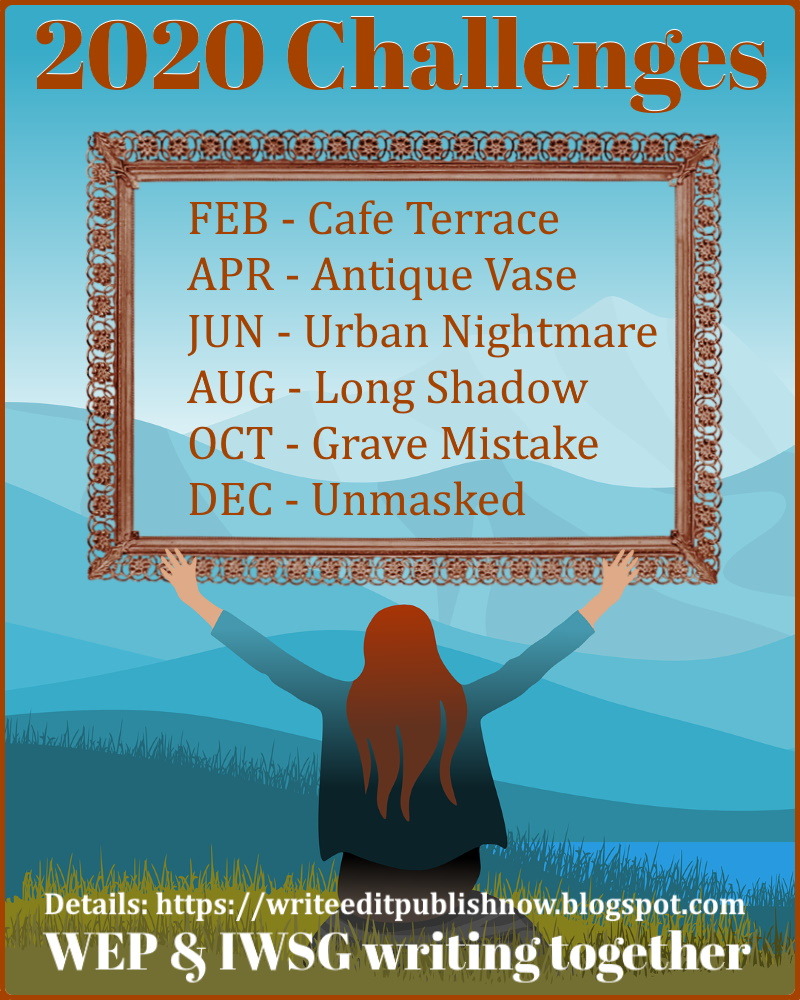
Please click on my sidebar to read more WEP entries. If in the future you'd like to write for us, check out our website! Our next prompt is in April. Yolanda Renee has returned as a WEP host. Yay! She will be hosting:


Isn't that intriguing? Why don't you join us?

And hello! WEP is celebrating its 10th anniversary in 2020! I  hope you'll join the fun writing competition at least once this year!


Wednesday, 11 December 2019

#WEPff December challenge - FOOTPRINTS - my #ff, On Top of the Mountain


It's the final WEP for 2019. It's been a great year and we've seen some great writing. Hoping there's some time in your hectic holiday or work schedule to do the rounds and read some pleasurable writing. Thanks to the team - Nilanjana Bose, Olga Godim and L.G. Keltner who've helped provide strength and purpose.


Here's my fun contribution to the December challenge.

On Top of the Mountain


On top of the mountain was where Ciara longed to be—leaving behind all her insecurities, her unhappiness, her confusion over the breakup with Tod. That was why in her backpack she’d tucked her special passport to tackle the road from France to Spain. The Camino de Santiago. She was following in the footprints of 2.5 million pilgrims who every year attempted to walk the 800 kilometre (497 miles). Each morning, she flew out of bed like a bird. Then for hours on end - trudge, trudge, trudge.

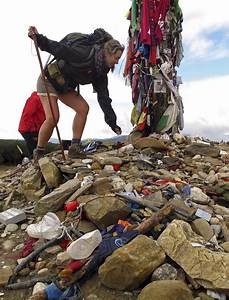
Whoever thought there’d be so many mountains, hills and valleys, especially at the beginning of the walk when most people were flabbily unfit? Her group all prodded their walking poles into the muddy ground, following the footprints of those in the lead. They took every opportunity to leave a token on every statue and shrine they passed, carefully placed rocks they’d brought from home and dropped them at the feet of saints like they were dropping their burdens. Of course they had to snap photograph after photograph on their smart phones, before whining and flopping beside the road, fanning themselves, pouring bottled water over their faces, until the guide finally called them out.

‘If you keep lagging, we’ll be camping beside the road in the rain instead of enjoying a drink, a nice hot bath and a comfy bed at the inn.’

That did the trick. Even Ciara smartened up her act.

The climb up this latest mountain had been hard in the drizzle, but Ciara had to admit, the view, or what she could see of it between the clouds, was Paradise.

She twirled round and round like the ballerina she was, fantasizing she was lead ballerina in Swan Lake, which she wasn't, then fell into a dizzy heap, like she was the frumpy ugly duckling everyone shunned.

‘Woops!’ She giggled, brushing off twigs and leaves, lying on her back, bathed in grey-blue sky. ‘Look on the bright side, girl!’

She was first.

She never got to be first.

She wasn’t even first with Tod. He’d chosen her because she looked like his first girlfriend. Ugh. That sure made her feel like the ugly duckling.

But today, despite Tod, was an important milestone in her life.

Her confusion was lifting like clouds on the mountain. Yes! She thumped the ground with her two fists. She came on this journey of self-discovery and she was self-discovering. Awesome. At thirty-four that wasn’t bad. Feeling smug, she sat up and leaned against the one and only scrappy tree and guzzled from her water bottle.

Now that her fitness had improved, she’d hurried ahead even though it was not the done thing. Truthfully, she was sick of the groups’ collective whining. Sure, the climb today had tested their fitness, but what did they expect? They were crossing the Pyrenees. All the way from St Jean Pied de Port in France to this splendid mountain range in Spain and then some. What a pilgrimage. What a way to start over. And it’d all be over in a month.

It was Roderick who riled her. There was always one. A pain from the beginning, whining about everything—the food, the weather, the lack of bottled water. He even complained when at one of the villages a kindly wine merchant provided red wine through one of the water taps, his contribution to the pilgrim walk. It’d helped them feel no pain through the rest of the day.

Still umpteen kilometres to go til they reached Santiago de Compostela. Could she put up with him that long? 

She was surprised their guide, Rafe, hadn’t sent him packing. Ah Rafe. She pictured his built body, muscled by years of climbing, and his piercing blue eyes, always focused on the beautiful landscape, never on her even though she did her best to attract him with her tight tops and lycra pants. She and Andrea, the other Brit, tried to outdo each other, rising earlier than everyone to hog the bathroom to apply their makeup. But Rafe was immune. She felt like stabbing him with her eyeliner when she caught him looking lovesick every time he glanced at Matthew, the royal marine from the U.S. Hot damn.

She dropped her water bottle beside the dozens of others abandoned by naughty walkers who’d never heard of climate change or that bottling water released 2.5 million tons of carbon dioxide into the atmosphere annually and took 17 million barrels of oil to produce a year’s supply. She sighed and looked into the haloes of whispy clouds and thought about how she was saving the planet by walking 800 kilometres instead of driving a car. 

She breathed in slowly, savouring the moment. Ah, first at last! Would Rafe be impressed? Even though she wasn’t a whiner, she was a lagger, and he was forever turning back to make sure she was still trudging onward. The look in his eyes accused her of lagging on purpose. She wouldn’t do that, would she?

Sniggering, she lost herself in murderous thoughts of Tod, but she wasn’t so lost she missed the grunting behind the scraggly bush where she’d propped herself.  

She carefully moved leaves aside and peered closer, afraid it was some weird Spanish animal of the four-footed species. Why think the worst? She was drawn to valleys made dark by black shadows. Why did she always see the dark side? ‘What the—?’ She suspended her deep psychological musings. Lying spreadeagled, a head wound gushing blood, was that whiner, Roderick.

‘Hey, Ciara what have you found?’ Rafe had arrived, the group behind him, a motley crew gasping, whining, mopping foreheads with kerchiefs.

She shook her head.

Life was a sick joke.

She never got to be first.

But look on the bright side, she thought. Roderick could have been some dangerous animal.


MERRY CHRISTMAS EVERYONE!

WORD COUNT: 974

NCCO - Comments only. This was written specifically for WEP just for fun. Enjoy!

STATE YOUR FEEDBACK PREFERENCES

Please click on names at the end of my post and read more stories and encourage our faithful writers who turned up for the Christmas challenge!

Look what we have in store for 2020. Those of you who are lurking behind the scenes I hope you can find a challenge that floats your boat!
The next WEP challenge will be in February. I hope you'll join us for:


Looks delicious!

Merry Christmas! Happy New Year!