Wednesday, 25 March 2015

Is the pen mightier than the keyboard? Thoughts anyone?

Hello there!

What do you think? Is letter writing dead? Do you think those days are gone when buying stationary was a beautiful fetish? Where giving/receiving a gift set of notes and envelopes was actually quite nice? Oh, and some smelled pretty too! How about a leather writing compendium complete with expensive pen? A yearly agenda planner and a not-so-expensive pen?


Our Australia Post has recently practically declared bankruptcy as no one sends letters anymore. So their response was to double the cost of a stamp. Well, that'll stamp it out altogether.

So by all evidence letter writing seems to be yet another dying art, along with 'proper' English, landlines, taking phone calls instead of messages, regular SLR cameras etc.

Image result for image of a teenager looking at a letterSo, what's the cause of this demise? That's easy, isn't it? Email's the go (although it's already old hat according to my Face-timing, Snapchatting students). Twitter and texting and facebooking are quicker and easier, so why write a boring old letter say you?


But the death of the letter really kills me.

A person born in the last 20 years may never have sent or read a handwritten letter. Wow! Really! The thought of picking up a pen and writing a personal message to someone seems foreign to the young and now many of the not-so-young. But don't handwritten letters offer a unique and personal touch that can never be replicated in our 'new' ways of communicating?

Are our mailboxes just for bills? Ugh!

Is a major literary era on its last legs? Double ugh!

The written word is undeniably the most dynamic discovery of human history that sets us apart from the animal world and personal letters have traditionally been an important literary medium.

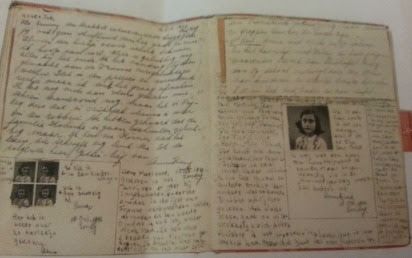
JK Rowling is a prolific modern day letter writer. But if we want to, we can also read the letter collections of writers such as Beatrix Potter, Jane Austen, Ernest Hemingway, Graham Green as well as some of the famous political leaders of the 19th or 20th centuries. And who could forget Anne Frank's handwritten diary?
A couple of precious pages from Anne's diary I snapped at
Anne Frank Haus, Amsterdam
Handwritten letters create a connection that modern, impersonal forms of communication will never approach. No doubt there are writers whose emails are worth collecting, but if they're locked behind passwords they're inaccessible.

Old French postcards written during war time
Collections of handwritten letters cover a vast array of topics. Queen Victoria was a prolific letter writer. She wrote about 3700 letters to her confidante alone! And isn't it romantic when a stash of love letters are discovered, especially those bound by satin ribbons. In war time letters are written to those at home. Very poignant they are too. So important that many of them are housed in War Memorials and Museums. They provide invaluable eye-witness evidence of the horrors of war. Will emails from a tour of duty in Afghanistan hold up against the letters from the trenches in WW1?

Did you have a pen pal when growing up? I had several. How I enjoyed receiving those light airmail letters replete with the daily doings of a life in Japan, or Canada, or Alaska. Had far more appeal than a Facebook post or two hundred.

I recently read an article that claimed that highest-level communiques should be hand written in an effort to thwart spying. So maybe it's back to the future in some areas!

 US President Barack Obama said in 2012: 'In my life, writing has been an important exercise to clarify what I believe, what I see, what I care about, what my deepest values are.' 

That man does have a way with words.



  • Do you still write personal letters?
  • Does the demise of personal letters worry you or are you all for technological ways of communicating?
  • Do you ever hand write your stories? 

Tuesday, 17 March 2015

Is there a 'right' way to publication? Author Adria J Cimino shares her success story.

Hi all!

Lovely to see you here. If you check out my sidebar, you'll see I've read 28 of my 120 books for the goodread's challenge. Many are Paris inspired which is what led me to today's post. 

An author who writes Paris-inspired novels contacted me through goodreads and I've been very happy to check out her blog. Recently I read her interview on Huffington Post where she recounted about her publication journey. 

Everyone has their unique 'publication' story. It's a topic I'm always interested in, so I invited Adria to visit my blog and share her thoughts re Indie and Traditional publishing.

So settle back and enjoy what Adria has to say.

An Indie Path to Publication
By Adria J. Cimino

Is there a ‘right’ way to publish?

I used to have a literary agent. I still remember my delight the day I signed the contract, naively thinking I was on my way to success. Months passed. Years passed... 

The glory days of self-publishing arrived, and I watched the books of self-published authors and those publishing with smaller houses climb the rankings. My agent agreed to publish my debut novel as an e-book through his agency’s imprint but told me I would be on my own in terms of marketing.

As my indie friends continued to progress, I found myself stagnating. My novel, “Paris, Rue des Martyrs,” was literary fiction and I soon learned that many readers of literary fiction prefer print books to e-books. So much of my audience actually wouldn’t even have access to my book!

My literary agent was set on the e-book path, and our strategies simply diverged. The decision seemed obvious, yet felt like free falling. Drop the agent. And so I did, going for the free fall. A scary proposition for someone like me, who had imagined that traditional path to publication for so long.

I could have self-published, but another idea was cooking in my mind. There were plenty of new authors around who found themselves in situations similar to mine. And that is how Velvet Morning Press was born.

Fellow author Vicki Lesage and I joined forces, pooled our skills and formed this small indie publishing house, aimed at publishing our books as well as the books of others. Why not take all that we learned in editing and marketing our own books and apply it across a broader scale? We moved forward, full speed ahead.

We re-released “Paris, Rue des Martyrs” in paperback as well as in e-book format. We published a multi-author short story anthology, “That’s Paris: An Anthology of Life, Love and Sarcasm in the City of Light,” and released my second novel, “Close to Destiny.” 

Next up, on April 17: “Legacy,” a short story anthology including award-winning author Kristopher Jansma and New York Times best seller Regina Calcaterra. 

Through my work marketing my own book and now my work with Vicki Lesage at Velvet Morning Press, I realize that there isn’t one “right” way to publish. One thing is certain though: More and more authors are turning to some form of indie publication.

How to make the decision?

Here are the positives/negatives I considered before choosing what path to take:

Indie
Positives: shorter time to publication, higher percent of royalties, larger role in decision making
Negatives: difficulty getting the attention of major media, difficulty getting into some bookshops

Big Publisher:
Positives: easier access to major media, greater access to bookshops
Negatives: lower royalties, cash advances are lower than in the past, longer time to publication

And what’s equal? Publicity. Unless you’re J.K. Rowling, chances are, even if you are published through a large publishing house, you will have to pitch in to some degree on your own marketing.

So there you have it, my story and a few tips so that you can embark on your story.

Happy Writing!

Thanks for visiting with us today Adria. So...if you'd like to check out Adria's books, here are the links. I'm currently reading 'close to destiny' and am enraptured.

 BOOK LINKS:

 “Close to Destiny”:
http://www.amazon.com/Close-Destiny-Adria-J-Cimino/dp/0692346945

“Paris, Rue des Martyrs”:
http://www.amazon.com/Paris-Rue-Martyrs-Adria-Cimino/dp/0692335072

“That’s Paris”: 
http://www.amazon.com/Thats-Paris-Anthology-Sarcasm-Light/dp/0692340114


Adria J. Cimino is the author of novels “Paris, Rue des Martyrs” and “Close to Destiny” and is co-founder of indie publishing house Velvet Morning Press (http://www.velvetmorningpress.com). She also is a contributor to short story anthology “That’s Paris.” Prior to jumping into the publishing world full time, she spent more than a decade as a journalist at news organizations including The AP and Bloomberg News. Adria is a member of Tall Poppy Writers (http://tallpoppies.org/) a community of writing professionals committed to connecting authors with each other and with readers. In addition to writing fiction and discovering new authors, Adria writes about her real-life adventures in her blog “Adria in Paris.” (http://adriainparis.blogspot.com/). You also may learn more about Adria and her work by visiting her website at http://ajcimino.com/ or following her on Twitter at https://twitter.com/Adria_in_Paris.

  • If you're published, share a little of the path you took to achieve your goal.
  • If you're still seeking publication, how is your  journey going?Check out Velvet Morning Press.
  • Did Adria's story help you in any way?


Wednesday, 4 March 2015

IWSG. Hunting and Gathering..things I wish I'd known about the beginning stage of writing a book.

This is my IWSG post.  Thanks to Alex J Cavanaugh and his team this month for all the work they put into this so very useful meme. Click here to read more posts...

The beginning stage of writing a book.
Some authors claim that there are two phases in the book-writing journey--(i) 'Hunting and Gathering' (my term) and then (ii) Building (my term), meaning Structuring. In previous novel-writing attempts, I've spent too little time Hunting and Gathering and too much time developing structure and shuffling deck chairs that would later get blown away in a cyclone of editing. Pure waste of time.

I came across this post by the wonderful Mary Carroll Moore, - artist, author, teacher. She says it's very helpful to know what phase you are currently in, so you are using the appropriate tools. Maybe it'll even stop you from getting discouraged or overwhelmed. Wouldn't that be nice?

Hunting and Gathering Phase - the clues 
  1. You have your story idea, but maybe you still feel unsure about it.
  2. You are enjoying exploring facets of ideas, perhaps freewriting but you're not ready to edit or structure yet.
  3. You have lots more research or interviews to do (maybe you haven't even started this). You need to dig deep into the characters you want to people your book with--profile? backstory for each? character arc? These may change a lot during this stage.
  4. .
    Source *
  5. Brainstorming ideas--this can be the fun part! Let your imagination soar! It is very helpful to brainstorm with a writing group or writing friends. Many brains are better than one!
The Hunting and Gathering phase keeps on happening throughout the book journey. As Moore says: 'We cycle in and out of it, but we always start with it: an idea, a nudge to write, a character that won't leave us alone, a compelling body of information we want to share, an experience that changed our lives.'

 The Three Main Components of Hunting and Gathering (with thanks to Moore): 
  1. Inner and outer story -Inner story is the meaning, the why.  Outer story is the event or what's happening, where, with whom, when.   Most writers naturally excel in one of these. This "outer story" information is crucial, but it's only half the picture. Inner story counts equally-the meaning of the plot (what changes because of what happens) and the meaning of the research (what does it mean to your reader). 
  2. Writing in islands (instead of by outline or chronology).  Islands are single scenes, or snippets of information, or a setting description, or a character sketch. They do not necessarily have a beginning, middle, and end. Writing teachers have discovered that writers who work in islands rather than via an outline often include the inner story more readily. This is because islands are not gathered in a linear fashion. They appear in random bits. I'm finding this a great way to 'discover' my story.
  3. Girl fisher
    Is this a keeper?
  4. Brainstorming list. A primary Hunting and Gathering phase tool. Keeping a brainstorming list is the a very effective way to counteract writer's block-you always have something to write about. And if you can free yourself from having to write your book in sequence, or chronology, islands can be tackled in any order.
After you are satisfied with your Hunting and Gathering, you are then ready to start Building (structuring your novel). I'm looking forward to this! But I'm so enjoying Hunting and Gathering and writing in islands at the present. I think my writerly advice would be: take your time! What's the hurry?


  • How about you? What stage is your writing at? Have you got any pearls of great price to add?
  • If you don't have Mary Carroll Moore on your blogroll, I highly recommend her great writing advice. She also offers online courses.


Tuesday, 17 February 2015

Tying the knot? Or tying your guests in 'nots? What do you think of modern weddings?

Hi everyone!

I picked up a new chick-lit today and it began with a wedding invitation:

Amazon link: 
You are invited to attend the nuptials of Audrey McCarthy and Joseph Bourke

The bride and groom kindly request the following:

  • No female guests to wear white; this includes clothes, shoes and/or accessories
  • Guests should refrain from wearing garments from Coast or Karen Millen clothing stores
  • Guests should please visit laceconfetti.com/mccarthy-bourke to review the colour scheme of the wedding and dress accordingly
  • Single male invitees should not bring as dates female guests who are unknown to the bride and groom
  • All non-local guests should stay at the hotel in which the wedding reception will be held (prices and information available online at www.themanor.com
  • No gifts on the day unless in the form of cash or cheques. Preferred method of gifting is via the wedding list (see attached notification card for details) or through deposits to the couple's joint account (details below) by the date of the wedding.
Mamma Mia! (2008) PosterFresh from watching Mumma Mia for the umpteenth time on television last night, here I come across another type of wedding, a far cry from the haphazard, raucous preparations of Meryl Streep and Co on the gorgeous Greek Island of Skopelos. Who cares about anything but the view?! Or Pierce Brosnan trying to sing, yet melting hearts at the same time? Or seeing 'Diane' from The Good Wife in a completely different light to the high-powered lawyer she plays on the modern show?

So this book beginning got me thinking about how weddings have changed so much in recent times. Often there is no gift table, or at the very least a Wishing Well for slackers to drop monetary gifts into if they haven't seen fit to organise ahead of the big day. 

Children have practically disappeared from wedding lists as venues are so expensive today, and really, who wants littlies running riot underneath tables and chairs? Well, I do. Really adds an extra fillip to proceedings.

I recall a time when it was quite acceptable to bring a date who was not known to anyone attending the ceremony.

And we know how those hotels hosting wedding receptions rack up their prices while at the same time telling guests they have a special rate for invitees--especially expensive! 

But to be told explicitly what not to wear is a little rude, don't you think? We all know the unwritten, or written rules of wedding etiquette due to the time of day the ceremony takes place and the strictures about wearing white or cream or black or whatever...but these days I would have thought the rules would be slacker than they were back in the day--geez, I've seen brides or bridesmaids in black, so I wonder what is going on with weddings these days?  

  • What was your wedding like? Did you have any strict criteria for invitees?
  • Do you agree that the weddings of your children will be a far cry from your own wedding (if you're married, of course!)
Now I'll excuse myself and get back to this book. Not too bad, although a bit annoying...:-)

Wednesday, 4 February 2015

IWSG post--techno problems, PANTSER or PLOTTER---which are you?

Happy February!

I missed January's IWSG, caught up as I was in a technical problem concerning feedburner not updating my posts. In case you ever come across this glitch, my final solution was to 'ping' feedburner. Magic! My updates began instantly!

Thanks as always to Alex J Cavanaugh and his worthy team who have made the IWSG such a runaway success! (Click on the link to access more posts or to sign up.)

As some of my long-term blogger friends know, I have various novels in various stages of dress/undress. The reason for this is that I'm a PANTSER, which is an exciting way to write, but it does lead to hitting brick walls at 100 kilometres per hour, and kaboom, CRASH!! Pick myself up, rev up the motorbike and try to find another direction...over and over...The bruises and broken limbs stack up, until finally that manuscript needs serious hospital treatment. While that story is taking up a hospital bed in an author-induced coma, it seems like a good idea to begin another novel...(I wrote about the PANTSER/VS PLOTTER here in another IWSG post if you want some more info on this phenomenon).

Well, I don't regret ANYTHING from my PANTSER days. I think the best way to learn to write a novel is to write a novel. I've read plenty of best-selling authors who say they have drawers full of first, second and third novels which until they are famous, no publisher wants to look at, and even then they may never see the light of day. That was probably while they were trying to work out what sort of a writer they were.

Random: Saw this sign at the Library Cafe this morning:

Writ-er
(noun)
1. A peculiar organism who is capable of turning caffeine into books.

So.., as those who picked up my 'how excited am I?' post about finally embarking on writing what I want to write...chic lit (not a typo) set in Paris...I can report that I am in the process of turning caffeine into a book. First, OUTLINING! D'oh, you say. Well, yes, d'oh, I am busily compiling a hand-written, sectioned book of notes on the main plot/sub plots/characters/settings blah blah...just like all of you clever authors who've been busily publishing books while I've been busily hitting brick walls.

An illustration by Kanako which suits my genre...perfectly
This month I'm very happy, not at all insecure...I know my subject matter and settings thoroughly thanks to several trips to Paris and greater France...now I just have to weave my winsome characters into the fantabulous City of Light...

And of course there are far too many books available on OUTLINING YOUR NOVEL. K.M.Weiland is one of the best for me. Currently I'm working on character arcs following the advice of Somerset Maugham who said:

"You can never know enough about your characters."


I'm back at work and have all the lovely students I can handle, working on literature like The Crucible and the usual dose of Shakespeare in the form of The Merchant of Venice, Othello...just for starters.

How about you this month? How is your writing going? And please share--how do you approach a new novel/short story? Do you know your characters in depth before you begin your story?