
Happy New Year!!
'You are all a lost generation.' Gertrude Stein
'One generation passeth away, and another generation cometh; but the earth abideth forever...The sun also ariseth, and the sun goeth down and hasteth to the place where he arose...The wind goeth toward the south, and turneth about unto the north; it whirleth about continually...All the rivers run into the sea; yet the sea is not full; unto the place from whence the rivers come, thither they return again.' Ecclesiastes
I like to travel with a novel that says something about the country I'm seeing. Last trip to Paris I used Ernest Hemingway's A Moveable Feast and followed his walks around Paris. I also learned that he always put his writing first. He claims he wrote every day from 5 am - 12 noon, when he put down his pencil (but not until he knew what would happen next), then meandered downtown to meet literary luminaries such as Gertrude Stein, Scott F Fitzgerald, James Joyce, Ezra Pound et al, and discussed his work/their work, helping each other's art. (Pretty cool critique partners!)
My critique partners aren't travelling with me, but nothing suits my travels better than a Hemingway novel. Not everyone is a Hemingway fan - heck, he didn't write fantasy, sci-fiction, steampunk etc, genres that have huge followings today and are of the type many bloggers like to write. He wrote mainly chronologically, with sparse back story. He said he sweated over every sentence, every chapter, ruthlessly deleting any superfluous words. Some find his style sparse, but if you read and re-read his carefully-crafted stories you continue to find layers you previously missed. This is well expressed by the Evening News when they reviewed The Sun Also Rises -
'Hemingway captures atmosphere by reticence and breathes life into his characters by pages left unsaid...It is American; it is literature; and it is a first novel by a genius.'
Hemingway stuck to realism with a dash of dystopian. I'm no huntin', fishin', hard drinkin' kinda person, but Hemingway's always been my favourite author for reasons I can't possibly articulate. He's real and gritty with no frills, which I'm sure he learned from his journalistic days and his passion for the short story. He wrote about the world he knew, the world in which he lived and played. It is hard to separate him from his characters. I find Jake in Fiesta: The Sun Also Rises, impossible to separate from Hemingway himself. As they say, many early novels are partly autobiographical.
I decided to make this novel my current travel companion, as it stars Paris and the louche characters that moved within its bars and restaurants, planning their next big adventure. The big adventure in this novel is, of course, the 'fiesta', the bullfight, in Spain. I've taken more notice of the bullrings in Spain this trip, and listened to the bullfight history enthusiastically propounded by locals and tour guides. In my ignorance I thought bullfighting had been banned, but it turns out it's only banned in Catalonia, capital Barcelona. The 'fiesta' is alive and well in the rest of Spain and the year seems to be dictated by where/when the next fiesta takes place. Madrid, the main bullfighting city, has a whole month of fiesta.
I've photographed many bullrings, but I don't know about you, I'm sure I couldn't stomach attending a bullfight.
To the main point of this post...in the excellent how-to writing guide - Manuscript Makeover - the author suggests as a writing exercise to find a paragraph from your favourite novel/author, and re-write it your way...
I was reminded of this exercise when I read a few paragraphs in Chapter 19, p.204, of The Sun...when the main character Jake is having dinner in Paris. I decided to re-write it using my own experience of a dinner in Paris in the Latin Quarter...with apologies to Hemingway and vegetarians...

'The restaurant was all reds and blacks. It wrapped its dark arms around me, welcomed me back after a long absence. The meal was typically French - plain peasant's food - mussels marinated in red wine which were dealt with quickly, then I was eating onion soup with soaked garlicky bread and long, stringy cheese which stuck to my chin. But what could beat the shot of sweet onion fragrance on a bitter winter's night? I wanted to live in the bowl, to be revived by the nourishing juices.
The waiter offered a free cocktail. I held the tiny jewelled glass against the light. Then I held it close to my nose, took a sip. It tasted of rose perfume, a sweet flavour that clashed with the onion. I pushed it aside and ordered a rosé to accompany the Beef Bourguignon which was delivered to my table. The sharp aromas of tiny roasted onions, carrot, and rich, red beef...my stomach danced. The onion soup was already a distant memory. I adjusted my linen napkin on my lap and inhaled before I lifted my fork and speared a cube of tender meat. The flavour of the red wine mixed with onion and herbs revealed to me, if the mussels and onion soup hadn't already convinced me, that I was back in France.
It was pleasant beyond words to be drinking good wine and eating excellent food - a bottle of wine and a plate of comforting food is always good company.
The attentive waiter saw I was immersed in my food and drink and left me to my joys.
It was good to be back in France.'
I enjoyed writing this and it proves that I do actually write while travelling, but apologies to Papa who would have slashed and burned many of my descriptions. To give you an idea of what I tried to emulate -
'I went in and ate dinner. It was a big meal for France but it seemed very carefully apportioned after Spain. I drank a bottle of wine for company. It was a Chateau Margaux. It was pleasant to be drinking slowly and to be tasting the wine and to be drinking alone. A bottle of wine was good company...' etc
How are you travelling? I wish you a wonderful 2014. Whether you make New Year's Resolutions or not (I don't), I invite you to join me in writing or illustrating something that could be classed as New Beginnings for Write...Edit...Publish's first challenge for the year. Sign up anytime from now until the 22nd...


'You are all a lost generation.' Gertrude Stein
'One generation passeth away, and another generation cometh; but the earth abideth forever...The sun also ariseth, and the sun goeth down and hasteth to the place where he arose...The wind goeth toward the south, and turneth about unto the north; it whirleth about continually...All the rivers run into the sea; yet the sea is not full; unto the place from whence the rivers come, thither they return again.' Ecclesiastes
The above taken from the forward pages to The Sun Also Rises.
I like to travel with a novel that says something about the country I'm seeing. Last trip to Paris I used Ernest Hemingway's A Moveable Feast and followed his walks around Paris. I also learned that he always put his writing first. He claims he wrote every day from 5 am - 12 noon, when he put down his pencil (but not until he knew what would happen next), then meandered downtown to meet literary luminaries such as Gertrude Stein, Scott F Fitzgerald, James Joyce, Ezra Pound et al, and discussed his work/their work, helping each other's art. (Pretty cool critique partners!)
My critique partners aren't travelling with me, but nothing suits my travels better than a Hemingway novel. Not everyone is a Hemingway fan - heck, he didn't write fantasy, sci-fiction, steampunk etc, genres that have huge followings today and are of the type many bloggers like to write. He wrote mainly chronologically, with sparse back story. He said he sweated over every sentence, every chapter, ruthlessly deleting any superfluous words. Some find his style sparse, but if you read and re-read his carefully-crafted stories you continue to find layers you previously missed. This is well expressed by the Evening News when they reviewed The Sun Also Rises -
'Hemingway captures atmosphere by reticence and breathes life into his characters by pages left unsaid...It is American; it is literature; and it is a first novel by a genius.'
Hemingway stuck to realism with a dash of dystopian. I'm no huntin', fishin', hard drinkin' kinda person, but Hemingway's always been my favourite author for reasons I can't possibly articulate. He's real and gritty with no frills, which I'm sure he learned from his journalistic days and his passion for the short story. He wrote about the world he knew, the world in which he lived and played. It is hard to separate him from his characters. I find Jake in Fiesta: The Sun Also Rises, impossible to separate from Hemingway himself. As they say, many early novels are partly autobiographical.
I decided to make this novel my current travel companion, as it stars Paris and the louche characters that moved within its bars and restaurants, planning their next big adventure. The big adventure in this novel is, of course, the 'fiesta', the bullfight, in Spain. I've taken more notice of the bullrings in Spain this trip, and listened to the bullfight history enthusiastically propounded by locals and tour guides. In my ignorance I thought bullfighting had been banned, but it turns out it's only banned in Catalonia, capital Barcelona. The 'fiesta' is alive and well in the rest of Spain and the year seems to be dictated by where/when the next fiesta takes place. Madrid, the main bullfighting city, has a whole month of fiesta.
I've photographed many bullrings, but I don't know about you, I'm sure I couldn't stomach attending a bullfight.
To the main point of this post...in the excellent how-to writing guide - Manuscript Makeover - the author suggests as a writing exercise to find a paragraph from your favourite novel/author, and re-write it your way...
I was reminded of this exercise when I read a few paragraphs in Chapter 19, p.204, of The Sun...when the main character Jake is having dinner in Paris. I decided to re-write it using my own experience of a dinner in Paris in the Latin Quarter...with apologies to Hemingway and vegetarians...
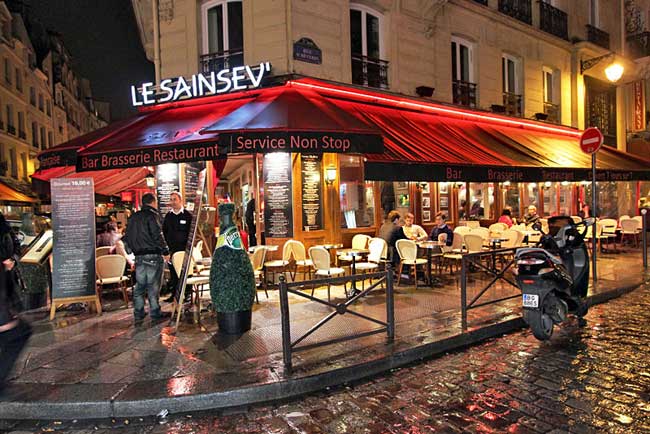
'The restaurant was all reds and blacks. It wrapped its dark arms around me, welcomed me back after a long absence. The meal was typically French - plain peasant's food - mussels marinated in red wine which were dealt with quickly, then I was eating onion soup with soaked garlicky bread and long, stringy cheese which stuck to my chin. But what could beat the shot of sweet onion fragrance on a bitter winter's night? I wanted to live in the bowl, to be revived by the nourishing juices.
The waiter offered a free cocktail. I held the tiny jewelled glass against the light. Then I held it close to my nose, took a sip. It tasted of rose perfume, a sweet flavour that clashed with the onion. I pushed it aside and ordered a rosé to accompany the Beef Bourguignon which was delivered to my table. The sharp aromas of tiny roasted onions, carrot, and rich, red beef...my stomach danced. The onion soup was already a distant memory. I adjusted my linen napkin on my lap and inhaled before I lifted my fork and speared a cube of tender meat. The flavour of the red wine mixed with onion and herbs revealed to me, if the mussels and onion soup hadn't already convinced me, that I was back in France.
It was pleasant beyond words to be drinking good wine and eating excellent food - a bottle of wine and a plate of comforting food is always good company.
The attentive waiter saw I was immersed in my food and drink and left me to my joys.
It was good to be back in France.'
I enjoyed writing this and it proves that I do actually write while travelling, but apologies to Papa who would have slashed and burned many of my descriptions. To give you an idea of what I tried to emulate -
'I went in and ate dinner. It was a big meal for France but it seemed very carefully apportioned after Spain. I drank a bottle of wine for company. It was a Chateau Margaux. It was pleasant to be drinking slowly and to be tasting the wine and to be drinking alone. A bottle of wine was good company...' etc
How are you travelling? I wish you a wonderful 2014. Whether you make New Year's Resolutions or not (I don't), I invite you to join me in writing or illustrating something that could be classed as New Beginnings for Write...Edit...Publish's first challenge for the year. Sign up anytime from now until the 22nd...


